
PorchesterPublishing · London

Coming soon

The Condensed Classics

A gateway drug to the classics.

You know who you are. You sort of think you should read the classics, but the unread books have become an important chore you keep putting off. The Condensed Classics gets readers with literary ambitions and the attention span of a fruit fly through the story, in the language they came to read.

Fat Free and Semi-Skimmed give you the real words, fewer of them, with new illustrated cheat sheets to keep you oriented. Call it literary sacrilege. Finishing the book is a useful place to start.

Explore the collection ↓

Getting hooked

Someone tells you about a book. You watch the adaptation, read a plot summary or end up on Wikipedia. Curiosity has already done some of the work. A condensed edition brings you into the prose itself: the dialogue, humour, ideas and turns of phrase that a synopsis cannot give you.

Start with either cut. If Fat Free gets you hooked, Semi-Skimmed gives you more; if you love it, read the freaking original. You can also finish a condensed edition and leave it there. Nobody has to earn permission to enjoy a book.

Choose your edition

Fat FreeSemi-SkimmedFull Fat
Two or four hours, guides includedFour or eight hours, guides included

The shortest route through the whole story, using the author’s prose. Start here if you keep abandoning the original or have never got round to opening it.

A longer cut with more of the scenes, conversations and description. Choose this if you already enjoy the author, or switch across from Fat Free when you find yourself wanting more.

The unabridged book, with every scene and digression. Each title in the collection links to the unabridged text, for when you decide the author deserves more of your time.

Switch as you read

The combined ebook links the two cuts at corresponding passages. You can move from Fat Free to Semi-Skimmed halfway through, read a scene at greater length, or switch back when you want to pick up the pace.

Fat Free and Semi-Skimmed also come as standalone editions. The milk names describe the cuts, not percentages of retained text.

The collection

First in development

Fat Free War and Peace

Leo Tolstoy

Love, family ambition and Napoleon’s invasion of Russia, in Tolstoy’s prose through a classic English translation. The original is as long as twelve copies of The Great Gatsby, or seven of the first Harry Potter, and takes about 47 hours of non-stop, undistracted reading. Fat Free is shorter than a single Gatsby, about half a Harry Potter, and takes four hours including the new illustrated guides; Semi-Skimmed takes eight. Relationship diagrams keep the families straight, while maps and timelines help you follow the war.

Estimated reading time

Original: ≈ 47 h

Semi-Skimmed: ≈ 8 h (83% less time)

Fat Free: ≈ 4 h (91% less time)

Condensed and edited by Porchester Publishing.

  • Fat Free Decameron Giovanni Boccaccio

    Estimated reading time

    Original: ≈ 24.5 h

    Semi-Skimmed: ≈ 8 h (67% less time)

    Fat Free: ≈ 4 h (84% less time)

  • Fat Free Metamorphoses Ovid

    Estimated reading time

    Original: ≈ 11 h

    Semi-Skimmed: ≈ 4 h (64% less time)

    Fat Free: ≈ 2 h (82% less time)

  • Fat Free Paradise Lost John Milton

    Estimated reading time

    Original: ≈ 7 h

    Semi-Skimmed: ≈ 4 h (43% less time)

    Fat Free: ≈ 2 h (71% less time)

  • Fat Free Divine Comedy Dante Alighieri

    Estimated reading time

    Original: ≈ 9.5 h

    Semi-Skimmed: ≈ 4 h (58% less time)

    Fat Free: ≈ 2 h (79% less time)

  • Fat Free Thus Spoke Zarathustra Friedrich Nietzsche

    Estimated reading time

    Original: ≈ 7.5 h

    Semi-Skimmed: ≈ 4 h (47% less time)

    Fat Free: ≈ 2 h (73% less time)

  • Fat Free Ulysses James Joyce

    Estimated reading time

    Original: ≈ 22 h

    Semi-Skimmed: ≈ 8 h (64% less time)

    Fat Free: ≈ 4 h (82% less time)

  • Fat Free In Search of Lost Time Marcel Proust

    Estimated reading time

    Original: ≈ 113 h

    Semi-Skimmed: ≈ 8 h (93% less time)

    Fat Free: ≈ 4 h (96% less time)

  • Fat Free Les Misérables Victor Hugo

    Estimated reading time

    Original: ≈ 46.5 h

    Semi-Skimmed: ≈ 8 h (83% less time)

    Fat Free: ≈ 4 h (91% less time)
  • Fat Free Don Quixote Miguel de Cervantes

    Estimated reading time

    Original: ≈ 35.5 h

    Semi-Skimmed: ≈ 8 h (77% less time)

    Fat Free: ≈ 4 h (89% less time)

  • Fat Free Brothers Karamazov Fyodor Dostoevsky

    Estimated reading time

    Original: ≈ 29 h

    Semi-Skimmed: ≈ 8 h (72% less time)

    Fat Free: ≈ 4 h (86% less time)

Where the cheat sheets came from

“When I was at school, I made cheat sheets for revision. They held very condensed information: what was happening, when it happened, dates and whatever else helped me remember it quickly. The point was to make a lot of material easier to grasp and retain. That is the thinking behind the guides in this collection.”

All killer, no filler.

We edit for momentum. Decisions, discoveries, reversals and consequences guide the selection, together with the character changes and essential ideas that give them meaning. Description and the material between those moments receive a harder cut. The result follows the story from beginning to end, ending included.

Cutting changes the experience. Atmosphere, accumulated detail and secondary lives lose space; words can carry a different weight when their surroundings disappear. Lovers of the original have reasons to object. These editions offer a pragmatic way through books that otherwise stay unread, with enough of their language to get a reader interested in more.

Cheat sheets for the reading

The new guides are part of the condensation. A family tree holds relationships in view; a timeline puts dates and events in order; a map locates the action. Compact explanations and visual representations of ideas help you understand and remember important information, including essential context from passages cut for length.

Each guide answers a question the reading raises, where you need the answer, without giving away what happens next. It has an accessible text equivalent. A diagram can carry a relationship or a sequence; the major dramatic scenes still belong in the prose. Guide reading and viewing time is included in the estimates.

A separate “What this cut leaves out” overview is the next extension of this approach: an optional, spoiler-labelled account of substantial omissions and what they contributed. It explains the losses rather than summarising every deletion. That overview is not yet part of the War and Peace pilot.

Inside War and Peace

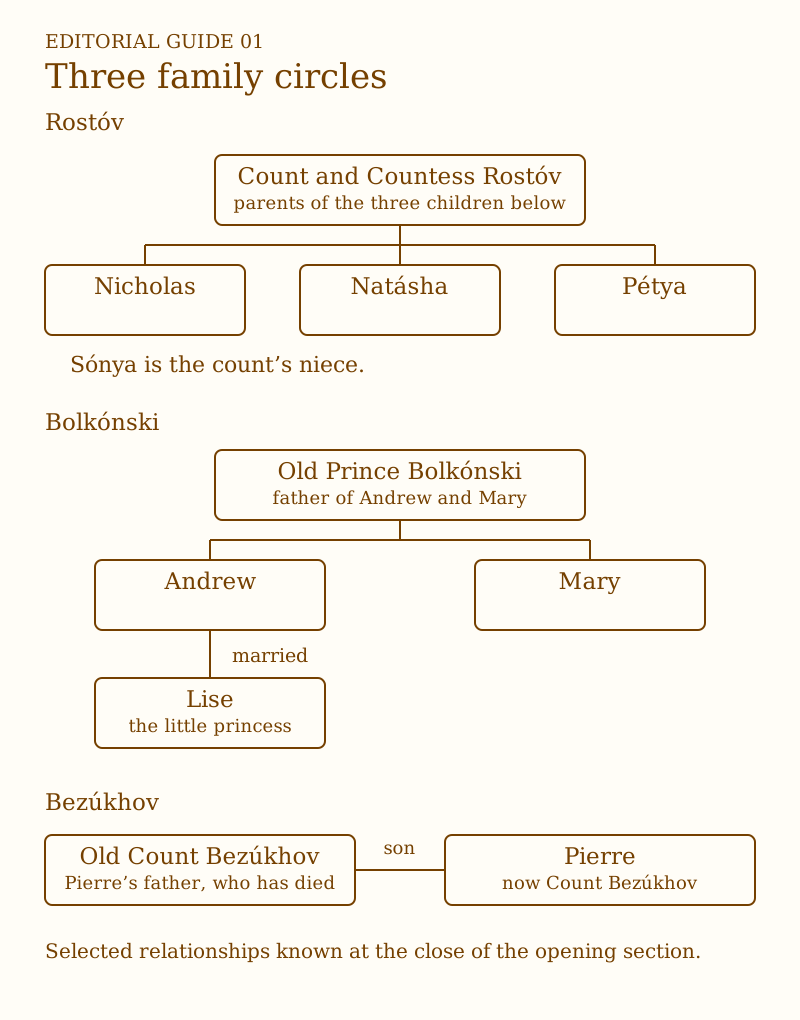
Two guides from the English-language pilot: a quick reference for the families and a way to place the campaign’s unfamiliar names. These are newly created editorial guides, separate from Tolstoy’s prose.

Three family circles

Selected relationships, not a complete family tree. Includes details from the opening chapters.

English-language map of the Rostóv, Bolkónski and Bezúkhov families. Full text version below.
Editorial relationship map · English pilot
View full-size diagram
Read the family map as text

Rostóv household: Count and Countess Rostóv are the parents of Nicholas, Natásha and Pétya. Sónya is the count’s niece.

Bolkónski household: the old prince is the father of Andrew and Mary. Andrew’s wife is Lise, the little princess.

Bezúkhov household: Pierre is the old count’s son. His father has died, and Pierre is now Count Bezúkhov.

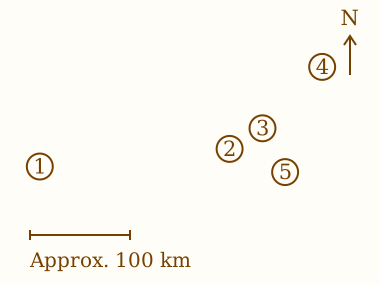
Places in the 1805 campaign

Translation names paired with modern settlements. The points mark settlements, not battlefield positions, army routes or historical borders.

English-language orientation map with five numbered settlements, north arrow and approximate 100 km scale. Place key and full text version below.
Editorial place map · English pilot
View full-size diagram
  1. Braunau · Braunau am Inn
  2. Krems · Krems an der Donau
  3. Schön Grabern · Schöngrabern
  4. Austerlitz · Slavkov u Brna
  5. Vienna · Wien
Read the place map as text

North is up. Numbered points mark settlements.

Braunau lies west; Krems northeast of Braunau; Schön Grabern northeast of Krems.

Austerlitz lies farther northeast; Vienna south and slightly east of Schön Grabern.

Spacing and scale approximate geography, with a scale of about 100 km. No movement order or battle formation is shown.

Coordinate data: Wikidata, CC0.

The words and the evidence

In the Fat Free War and Peace pilot, 99.85% of the narrative wording is verbatim from Louise and Aylmer Maude’s translation: 40,965 source words and 61 introduced or altered words. This measures where the words come from, not accuracy or completeness. It excludes headings, guides, front and back matter, diagram labels and the source footnote.

We try to add nothing to the narrative. You read the author’s prose in the original English or a credited classic translation. Essential additions or alterations appear in brown square brackets. New headings, cheat sheets, diagrams and guide explanations are editorial material, also brown and clearly separate from the source prose.

See how unevenly the cuts fall

The cut retains 7.27% of all indexed source words, including source footnotes. Across seventeen divisions, retention ranges from 4.42% to 15.10%. Of 365 chapters, 155 contribute no wording, 28 retain at least a quarter and three retain more than half.

Source words retained, by division

All bars use the same 0–20% scale. The last two divisions are the two epilogues.

  1. Book 15.05%
  2. Book 24.42%
  3. Book 35.74%
  4. Book 47.81%
  5. Book 56.28%
  6. Book 65.53%
  7. Book 75.31%
  8. Book 87.94%
  9. Book 95.37%
  10. Book 106.24%
  11. Book 115.46%
  12. Book 1213.08%
  13. Book 1310.38%
  14. Book 1415.10%
  15. Book 1511.98%
  16. Epilogue 110.60%
  17. Epilogue 210.93%

These figures demonstrate uneven selection. Establishing how much more description is cut than plot requires a separate classification of the source passages. That editorial priority has not yet been quantified by narrative function. The figures describe this pilot, not every title; they do not establish reading pace or fidelity.